What One Night in Nature Taught a CEO About Work and Rest
Brad Krauskopf, CEO and Founder of Hub Australia, on his first time off-grid during work-time.
Brad Krauskopf is the CEO and Founder of Hub Australia, Co-Chair of Flexible Workspace Australia, and a long-time advocate for the future of flexible work. Here’s at his first time working off-grid with Unyoked.
As a rule, I liked to have a plan. Before I started my journey to Esti, just 1hr N of Melbourne in the Macedon Ranges, I had a pretty solid idea of what I thought was going to happen, how I was going to spend my time, and a list of things I was going to "achieve."
Sure, I wanted to disconnect, but I wondered how easy that would be in just 24 hours, especially given the curveball phone call I had en route to the cabin and the flurry of emails I had to send in the carpark before I started my trek. After frantically firing off my final, last-minute email—I check in with my family. Then, for the first time in a long time... silence. Just me, my thoughts, and my to-do list. There’s something about the forced quieting of your brain through intentional disconnection. As the buzzing of notifications from my phone drops away, so too do my buzzing thoughts.
The Unyoked experience begins with the walk to the cabin, I know this by design. I’ve read enough research to know that movement shapes thought, and as my steps fall into rhythm, I realise: this time off-grid is going to be slower than I expected.
So much for my plan.
Over the afternoon, I journal. I jot down notes and ideas for a workshop. I reflect on my goals from January and set new ones. But in between these periods of work, my focus drifts. It’s welcome, this drift at a slower pace.
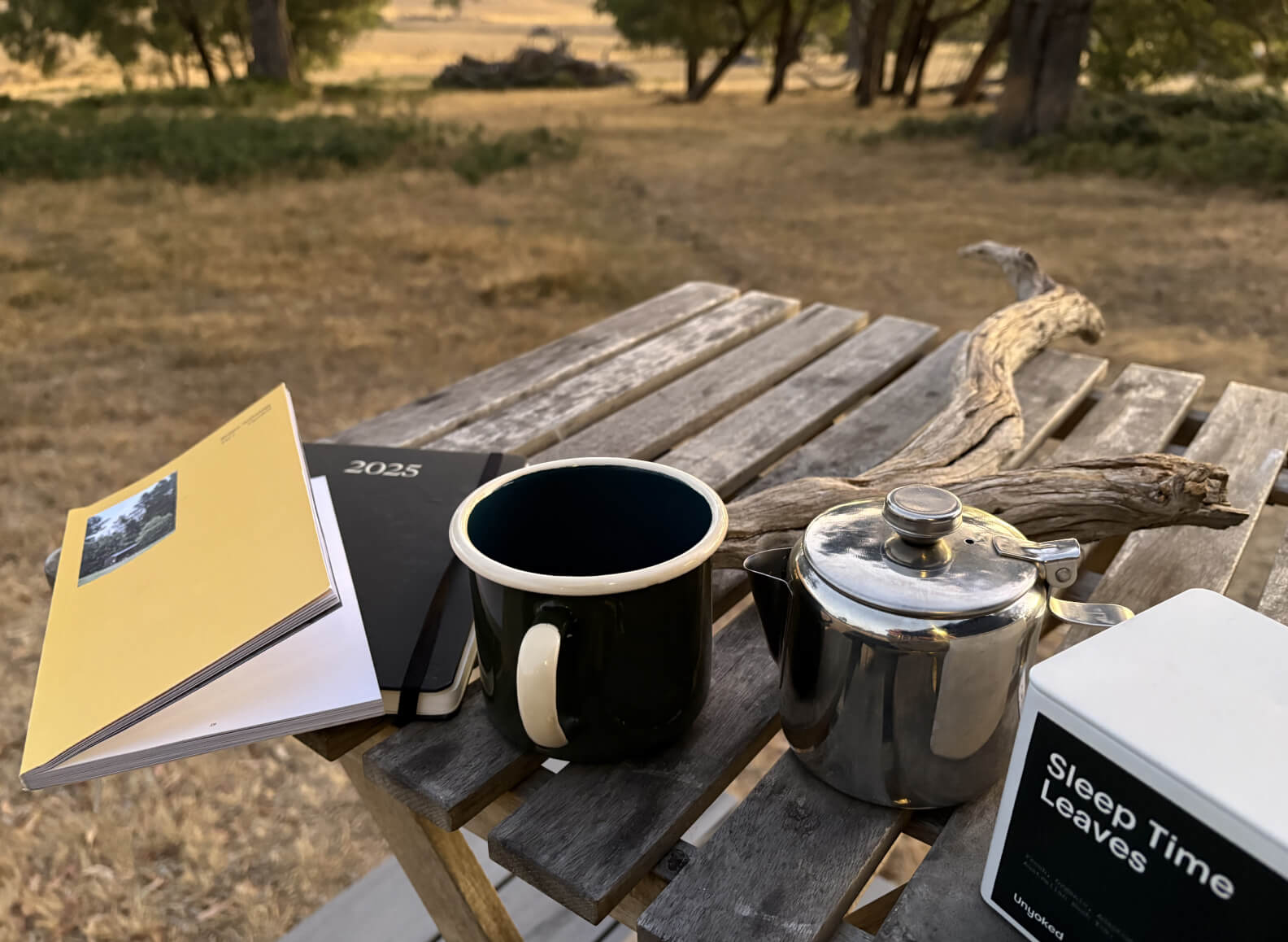
Before I know it, I’m flipping through a book from the cabin instead of the one I packed. The tape deck is on the table, a cup of tea in my hand. I take a run beside cows in the field.
And though it feels unstructured—this back and forth between work and rest—there’s a rhythm to it. An ebb and flow that's almost instinctive.
Everything here nudges me into a slower rhythm. From the steps away from my car to the ritual of hand-grinding coffee beans, even the very type of coffee machine available in the cabin is actively slowing me down. There are no pod machines here, just a press and a pour-over. I opt for both.
The thing that I want the most here though, is time.
When it’s time to pack my bag and say goodbye to the kangaroos, I tell myself that next time, I’ll stay longer. And even then, I know it won’t feel like enough.
Maybe it’s because, out here, time moves differently—less about deadlines, more about moments. It slips by in a way I didn’t expect, unstructured but not wasted. The plan in my head never quite materialised. And while I’m certain I’m not the only Unyoked guest to experience this, I suspect, it is part of the magic.
Maybe next time, I won’t need a plan at all.
A Further Note from the Author:
While this journal reflects the shift in mindfulness that comes with time spent in nature, the effects were also backed by data. Activity tracking revealed measurable changes in my body’s response to stress and rest.
After my stay at the cabin:
Time spent awake during the night decreased by more than 50%.
Time spent in REM sleep nearly doubled.
Time spent in deep sleep nearly tripled.
Heart rate variability increased from 45 to 71, indicating a stronger stress response.
All this, from just a little time in nature.
If you can, stay for two nights. That’s my plan for next time. But as the numbers show—even one night makes a difference.