'Even indoor kids can enjoy the outdoors': lessons from 10 Unyoked stays
Since 2020, Jess Price has stayed at Unyoked ten times. Over 10ish questions, she shares what drew her out there, how to tap into nature when you're not the outdoorsy type, and her take on the future of work.
1. Tell us a bit about yourself?
My goal in life is to move slow and build things. I'm highly creative, curious, analytical and strategic, which, until recently, made it difficult to understand my place in the world. Now I love spending time on random adventures with the people closest to me, taking photos and investigating why things are the way they are. As a lifelong indoor kid, it's a little surreal that I'm being interviewed for a journal about spending time in nature!
2. Talk to us a bit about your philosophy around the way we work?
We need to redesign work for the twenty-first century. Rising rates of burnout, slowing productivity and the conversations around AI aren't new. Historically, when we got new technology, we adapted how we worked, yet in our lifetimes, we stopped. Our current work philosophy was developed during the first industrial revolution as we moved from fields into factories. The second industrial revolution introduced scientific management theory, which still defines how we work a century later. The concept of burnout emerged in the 1970s, the start of the third industrial revolution, which I suspect is linked to the fact that factory processes were adapted to office work (I'm yet to confirm this theory!).
Through my company Paradigm Makers, I have a vision for the world in 2075 where all of our invisible systems are intentionally designed to allow flexibility for humans and structure where we need it. I don't know how we get there, yet, but I believe we can't leave future generations with the same challenges we inherited.
I believe we can accomplish this if we understand how we got here. That's why I started the Moonlit Minds Journal where each month I explore one topic from pre-1760 through to today to understand the logic we inherited and propose new design principles for the future. The journal is an opportunity to share what I'm learning, be transparent about the future Paradigm Makers is working towards and help others understand the type of work I do.
3. How did you come to it?
I had a job that made me severely anxious and depressed. While on 9 months leave, I realised it wasn't the result of anything I, or those around me, had done. It was a result of the systems and processes of work. I became determined to one day use my experience to prevent anyone else from going through what I did.
Recently, I was on my way to the Luen (Unyoked cabin), I wondered how we ended up with Saturday and Sunday as the standard weekend. I broke my no-phone rule to find out, which became my article 'Is it time to cancel the weekend?' In that moment, I realised everything we do was created by a person for a specific context, so I spent two years researching why work was the way it was. I quickly realised I couldn't fix mental health at work by focusing on mental health. Instead, we needed to rethink everything about the concept of work. So that's what I'm doing.
4. You've talked about systems not being broken - they were built this way. What's the system you most want to rebuild?
The short answer is the system of work.
The long (and important for context) answer is that I want to prevent anyone else from being exposed to psychosocial hazards (the risk factors that impact our mental health at work). In order to do that, there's not one system I can target. It means fundamentally rethinking everything we do. Trying to change something as complex as 'work' is what's known as a wicked problem. That means it's impossible to solve, there's no right or wrong answer, and every action impacts something else. All we can do is identify interventions that shift everything it touches in a positive direction (or acknowledge the risk if harm is unavoidable).
5. What was your first Unyoked cabin, talk us through that experience?
It was Neada, in November 2020 and after a year stuck in my inner-city apartment, I was craving silence. When I arrived and couldn't open the heavy wood sliding door. I panicked, realising I had to solve this problem on my own. Thankfully, a farmer came by on a tracker and opened it for me. It felt strange being alone. After a few hours withdrawing from my phone, I started to adapt to my surroundings. By 11 am the next morning, I'd finished the only book I brought with me and had no idea what to do with my boredom. That afternoon, I realised that even indoor kids can enjoy the outdoors in their own way. For the rest of my trip, I took random photos, walked around and searched for kangaroos (they were everywhere!)
6. After 10 cabin stays, you're a bit of a veteran now. What’s your go-to move when you land at a cabin? Do you have any rituals?
If it's an extra spicy cabin, I take a selfie to celebrate that I made it! Then I put away the food, make a stack of the 7+ books I optimistically hope to read, lie on the bed to catch my breath, take a photo of the view outside and turn off my phone.
My rituals begin the day before. I look at my giant stack of unread books and pick out the ones that speak to me.
I've created a 'Sequins in the Wild' photography series, so I also pick out a piece from my sequin wardrobe to bring with me. The morning of, I go to my favourite bakery in Melbourne (Kudo) for bread rolls and a sweet treat. Then I head to regional towns along the way to check out the op shops and boutiques. In the last town, I stop at a fancy grocer to get all the foods I want to try that feel too extravagant for everyday.
7. How's the experience changed and how have you changed over these stays?
I'm writing this on my tenth trip (Galeb)!
It's been six years since my first trip, and it's been nice to observe how Unyoked and I have evolved in that time.
In 2020, I was experiencing early warning signs my job was impacting my mental health, but I kept dismissing them. The morning of my first Unyoked, I remember excitedly waiting to receive a text with the cabin GPS coordinates, now there's a detailed digital field guide delivered as soon as you book. By the time I implemented my 'Quarterly Unyoked Retreats' in 2023, we'd both changed significantly. I'd gone freelance and you'd expanded into the UK and New Zealand. By 2024, I'd registered Paradigm Makers, and while cabin designs have remained mostly consistent, I've noticed some upgrades. In 2026, you've partnered with some of my favourite brands like The School of Life, and I'm achieving a goal I set for myself back in 2023 to one day write for the Unyoked journal!
8. Has being off-grid changed the way you actually work, or is it more about how you think about work?
Both. When I experience the awe of an incredible view or watch as the stars pass me by, I'm reminded that the world is so much bigger than whatever's happening at work. It's helped me accept, without guilt, that work doesn't need to happen in an office, sitting behind a desk. At first, I got nervous about how people would respond when I said I was offline for 4 days. Most people either don't notice, don't care or are curious to learn more.
While some of my trips have been purely to recover, I predominantly use my time off-grid as a 'quarterly retreat'. When you start a business, it's easy to forget to celebrate the small wins. Unyoked for me is a place to be 100% creative for 2 or 3 days without distraction. As a creative person, I spend a lot of time thinking and experimenting, but the city is designed for analytical people, making it hard to remain in the flow state necessary for creative work. I've noticed Unyoked is the place I go when I need to get something done. At Galeb (1.0), I identified freelance services. Luen, I wrote my first keynote speech about my lived experience with psychological workplace injury. Anant is where I researched business names (all of which were crypto companies), and I went to Santi when I was feeling particularly overwhelmed about the hard parts of running a small business.
I've also noticed it's helped inform the philosophy of what I'm building with Paradigm Makers. I'm currently thinking about branding and really want every colour to be nature-inspired. I also want visuals inspired by the connections that occur in nature without us noticing. Without Unyoked helping me reconnect with nature, I don't know if I would've taken this approach.
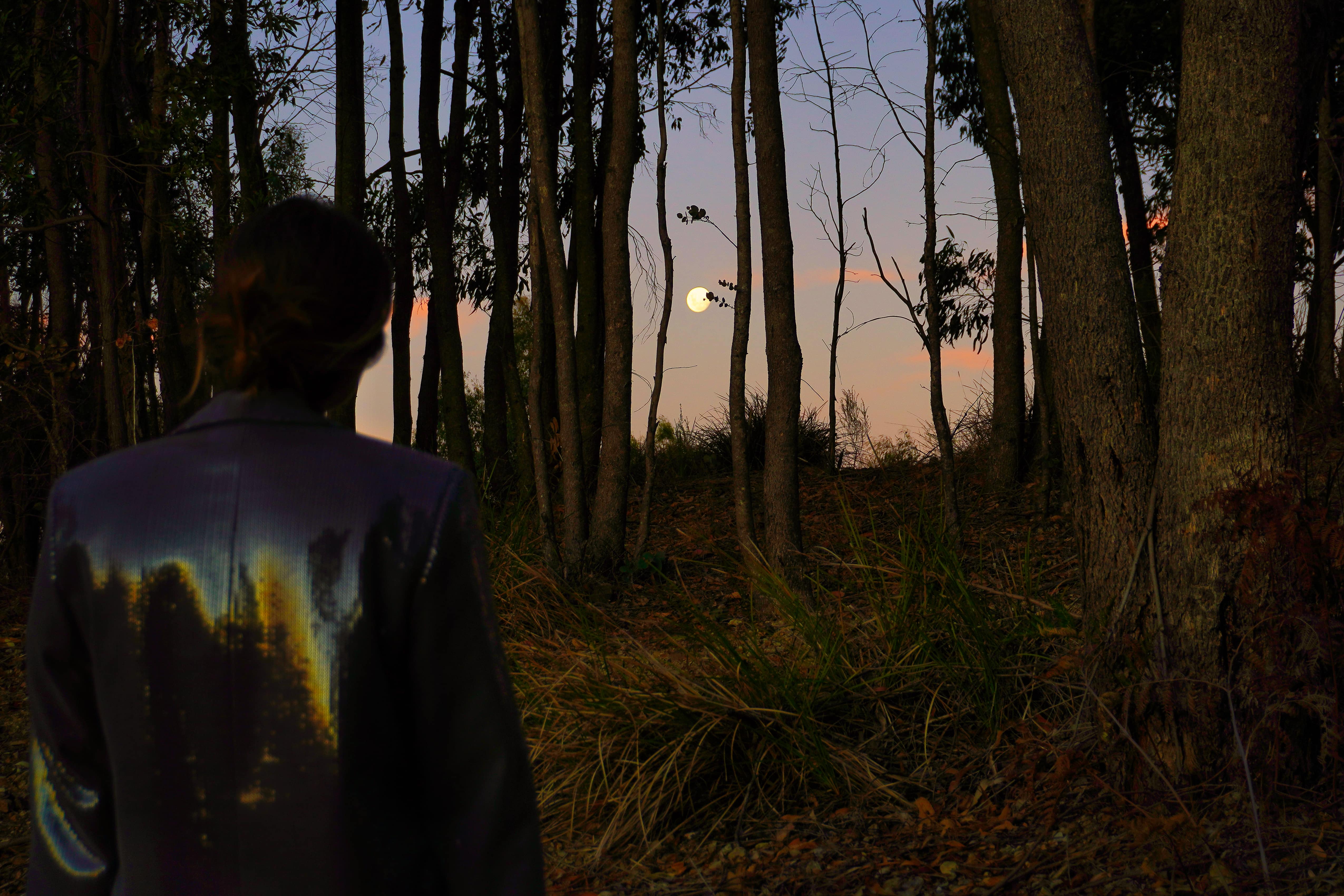
9. At what point did we design nature out of our lives, and do you think we can design it back in?
According to the random book, 'A Short History of Myth' by Karen Armstrong, I got at Woodend Bookshop on my way to Galeb (2.0) we lost our connection to nature in early civilisations (c. 4000 to 800 BCE): "The new technology gave city-dwellers a more complete control over their environment and they were becoming increasingly more distant from the natural world." (pg 58).
The global Humanise campaign is doing a great job making our buildings more human, which includes incorporating biophilic design. There are also small things we can intentionally do. Since my first Unyoked, I've started adding plants to my apartment to help me feel more connected to nature. I've also noticed that when it's been more than three months since my last Unyoked trip, I start to crave time in nature, which was really weird the first time it happened.
10. What do you think it means to thrive in modern life?
Return to a more human pace. We are not machines, yet since the first industrial revolution, humans have continued to increase our pace to keep up with machines. AI is highlighting how unrealistic it is to expect humans to keep up, yet it's all we know, so we keep pushing to do more. Instead, modern life needs us to focus on our uniquely human skills, like creative and analytical thinking, curiosity and resilience.
11. What would you say to someone who knows they need to stop but feels guilty about stepping away?
It's okay to take a break. You are human, and that means you were never meant to be on 24/7.
Since 2024, I've been intentionally trying to slow down, and it's been hard. Everything keeps moving faster and faster, yet there's an expectation that we remain constantly connected. Connection is important, but if you don't have the energy to connect with yourself, how do you expect to connect with others?